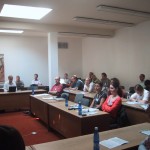
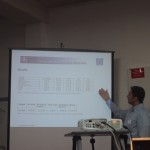
Today Hans Weigand from Tilburg University gave a seminar on Adaptive Service Oriented Architecture. Hans has also been visiting us this week for continuing our previous work on service modelling and management. In particular, we have been discussing how services can be analyzed using REA and value modelling.
New Project on Business and Process Models in Healthcare
SYSLAB has got a new project approved by Vinnova
Visualisations of patient centred process and business models in health and social care
Project proposal: Vector space representations of textual content
Today I handed in a project proposal to the Swedish Research Council (Vetenskapsrådet). Collaborating with me on this proposal are Magnus Rosell and Viggo Kann at KTH CSC as well as Magnus Sahlgren, Jussi Karlgren and Oscar Täckström at SICS. The title of the project is Vector space representations of textual content.
Abstract: Since the 1960s vector space models have been used extensively for representation of semantics, especially in information-retrieval systems such as Google. These vector spaces are usually multi-dimensional and the terms and documents are represented by very large matrices. There is no greater regard to context. For instance, how a term occurs in other documents is almost completely disregarded. Texts are thus viewed as mere bags-of-words.
Much of the research so far has either focused on the application of these representations on specific tasks, or on the efficiency of this application by, for example, reducing the dimensionality of the original space in some way. This project proposes the study of vector space representations of textual content in a more systematic manner.
We have identified two main tasks. One is to explore the notion of intrinsic dimensionality and the spatial metaphor often used in describing “likeness” between terms and documents. The other task is that of moving from a bag-of-words representation to a more informed document space, modeling more than just the cooccurrence of lexical items within documents. These models will be systematically validated on a diverse array of tasks and well established test sets with built-in success criteria.
A better representation of textual content is interesting in itself, but will also lead to better underlying models that will improve useful applications, such as search engines and text summarization.
Project Proposal on Business Models in Health Care
Together with Stockholms Läns Landsting, Karolinska Institutet, and Alkit Communications AB, we have submitted a project proposal to Vinnova on business models in health care.
Abstract
A major challenge in Swedish health care is to ensure quality and safety in health care processes shared between several care providers. Addressing this challenge will require a thorough understanding of the relationships between strategy and operational processes, which can be described by means of business models. The purpose of the project is to develop, describe and visualize a number of business models for cooperation and interoperability using e-services in health care. The business models will contribute to effective and efficient interoperability by clarifying the relationships between organizational strategy, primary and support processes, and technological infrastructure in terms of e-services. The business models will describe how health care is produced, the actors participating in this production, the value created for patients, and forms for financing. The resulting models can be used by politicians, care providers, and industry in order to create novel health care networks, innovative e-services, and alternative work organizations. The project is a cooperation between Stockholms Läns Landsting, Karolinska Institutet, Kungliga Tekniska Högskolan, and Alkit Communications AB.
Read more about work on business modelling at SYSLAB.
Hans Weigand visits SYSLAB
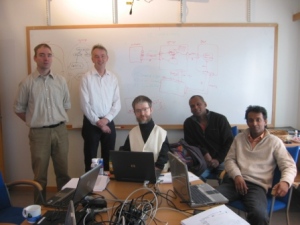
Hans Weigand from Tilburg University visited us at SYSLAB 17 – 20 Dec 2007. We continued our previous work on value and business modelling. In particular, we discussed how service models could be based on value models. We also discussed how value activities should be modelled, in particular the issue that a value activity may use and contribute to the same resource, e.g. knowledge.
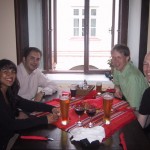
The figure shows, from left, Birger Andersson, Hans Weigand, Paul Johannesson, Ananda Edirisuriya, and Tharaka Ilayperuma.
Hans Weigand Homepage
Nodalida May 25-26, 2007, Tartu, Estonia.
Konstantinos Charitakis presented his EMIS master thesis in form of a scientific paper with the title “Using Parallel Corpora to Create a Greek-English Dictionary with UPLUG” at Nodalida 2007, the 16th Nordic Conference of Computational Linguistics, at University of Tartu, Estonia. Sumithra and Hercules joined him. Martin Hassel, CSC-KTH that soon will join our department presented also two papers “Widening the HolSum Search Scope” co-author Jonas Sjöbergh and “Linguistically Fuelled Text Similarity” co-author Björn Andrist, see also photos.
Paper by EMIS-student accepted to Nodalida 2007, Tartu, Estonia!
Konstantinos Charitakis that just finalized his EMIS-master and rewrote his master thesis to a paper submission with the title: Using a parallel corpora to create a Greek-English dictionary with UPLUG, submitted it to Nodalida 2007 and got accepted. We congratulate Konstantinos!
Abstract This paper presents the construction of a Greek-English bilingual dictionary from parallel corpora that were created manually by collected documents retrieved from the Internet. The parallel corpora processing was performed by the Uplug word alignment system without the use of language specific information. A sample was extracted from the population of suggested translations and was included in questionnaires that were sent out to Greek-English speakers who evaluated the sample based on the quality of the translation pairs. For the suggested translation pairs of the sample belonging to the stratum with the higher frequency of occurrence, 67.11% correct translations were achieved. With an overall 50.63% of correct translations of the sample, the results were promising considering the minimal optimisation of the corpus and the differences between the two languages.
University 2.0
Web 2.0 has received a lot of attention in the last years. Here is a compact definition from Tim O’Reilly:
“Web 2.0 is the business revolution in the computer industry caused by the move to the internet as platform, and an attempt to understand the rules for success on that new platform. Chief among those rules is this: Build applications that harness network effects to get better the more people use them.”
In contrast to much of the development in computing, the initiative for Web 2.0 has come from individuals and loose communities, and not from business or defense. Only recently, ideas from Web 2.0 has moved into business under the banner of Enterprise 2.0.
But how can Web 2.0 be applied in universities? The university environment should provide an ideal environment for realizing the networking required in Web 2.0 through its openness, creativity and lots of people with a lot of spare time :-). However, we need much experimentation before knowing which are the best ways to proceed. Here are some suggestions and open issues:
– Provide social network web sites for research laboratories and other groups
– Let students build and share knowledge bases in courses that are extended each year the course is given
– Provide virtual mentoring for freshmen
– Complement the master thesis writing process with an open review process
– Evaluate and classify courses and course contents through social tagging
– Use collaborative writing in project assignments
– Review and publish all student project work